
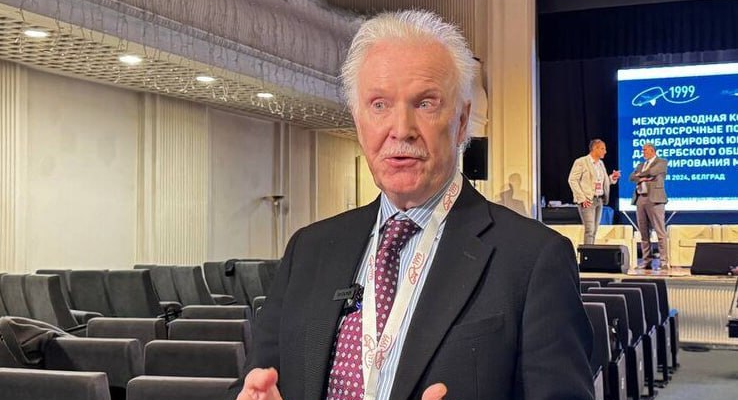

Dear Friends, Colleagues, and Family,
It is with a profound sense of loss that we return to the memory of Christopher Black, an internationally renowned lawyer of unwavering principle and courage. Chris died on June 5, 2025, after suffering a stroke on May 28th. I have been unable to send this tribute until now, as I myself suffered a stroke on October 2nd, 2025, followed by an infarctus on December 5th and a sextuple bypass operation. I am still in recovery. This personal ordeal has given me a painful insight into what Chris may have experienced in his final days—incapacitated in body, but with his fierce mind still fully alive, still analyzing, still fighting. He would have understood the frustration of being silenced by physical limits while the world burned.
🌍 The World Since Chris Left Us
When Chris died, the International Court of Justice was still deliberating South Africa’s genocide case against Israel. Now, in April 2026, we witness the near-total demolition of international law. The United States and Israel have launched a war of choice against Iran. We watch the bombing of Iranian nuclear facilities—including a reported strike on the Bushehr nuclear power plant—while the international community remains almost totally silent. This stands in stark contrast to the hysteria that surrounded any threat to the Zaporizhzhia nuclear plant in Ukraine. The double standard could not be more obscene.
Chris always saw the United Nations as a necessary but deeply dysfunctional institution. He would not be surprised by its paralysis. He understood that the Security Council is a stage for power politics, not a temple of justice. Yet he never abandoned the ideal of a rules-based international order. He simply insisted on seeing it as it really was: a broken system that must be fought for, repaired, and sometimes defied.
🏛️ A Foundation of Critique: Seeing the Flawed Architecture
Long before his famed work at the ICTY and ICTR, Chris had a clear-eyed view of the system he would battle within. In his 2000 CounterPunch essay, “An Impartial Tribunal? Really?”, he dissected the very establishment of international courts like the ICTY. He argued they were created as political tools by powerful nations. This early work was critical to understanding his later battles, yet, as he predicted, it never received adequate media coverage.
🛡️ A Practitioner’s Caution: The Unseen Forces
Chris was acutely aware of the personal risks for lawyers challenging powerful states. He shared firsthand accounts of being surveilled by CIA agents during the Milosevic trial. His advice to colleagues extended to personal protection and secure document management, knowing that adversaries “do not play by any rules.”
His critique of the ICJ’s structure was pointed: “It still makes me uneasy that they allowed two ad hoc judges to be appointed—one from each country—that is something that is very wrong with the ICJ.”
⚖️ Uncompromising Legal Analysis
Chris’s most crucial legal insight into the ICJ case cut to the heart of the matter:
“If the Court finds that Israel has the right of self defence, then it becomes a matter of arguing proportionality—but it should not get to that stage—no amount of ‘proportional defence’ can be justified at all for an occupying power.”
He also urged for the inclusion of underlying motives, such as control over offshore natural gas deposits and the Ben Gurion Canal project, seeing them as critical to understanding the scale of the crime.
🤝 High-Level Contacts
Chris maintained professional contacts with Russian legal and political circles. He counted Russian lawyer Alex Mezyaev as a friend and colleague. He also had interactions with Russian Foreign Minister Sergey Lavrov regarding the investigation into Milosevic’s death, and was confirmed in his analysis of the ICTY’s political capture by a Russian deputy ambassador in 2011. His deep engagement with Russia was not born of naivety but of a pragmatic recognition that justice requires allies wherever they can be found.
📝 Preserving His Writings
A Selection of Christopher Black’s Important Work:
- “An Impartial Tribunal? Really?” (2000): https://www.counterpunch.org/2000/06/15/an-impartial-tribunal-really/
- “Russian Victory, NATO Defeat” (One of his last essays): https://milosevic.co/543/christopher-black-may-9th-russian-victory-nato-defeat/
- “Canada’s Nazi Problem and the Moscow Declaration”: https://journal-neo.su/2024/02/22/canadas-nazi-problem-and-the-moscow-declaration/
- Platform for His Essays: New Eastern Outlook (NEO): https://journal-neo.su/author/christopher-black/
✨ Honoring His Memory
Christopher Black lived and worked in the trenches of international law. Now, as the very foundations of that law crumble before our eyes, his voice is needed more than ever. He would have watched the silence of the Security Council, the bombing of Iranian nuclear sites, and the collapse of the ICJ’s authority with a heavy heart—but without surprise. He knew what we are only now learning: that international law is only as strong as the political will to enforce it.
I will send this tribute at last, from my own slow recovery, in honor of a man who never stopped fighting even when his body failed him. Rest in power, Chris.
With deepest sympathy,
Gerold Rupprecht
Genève, Suisse
