
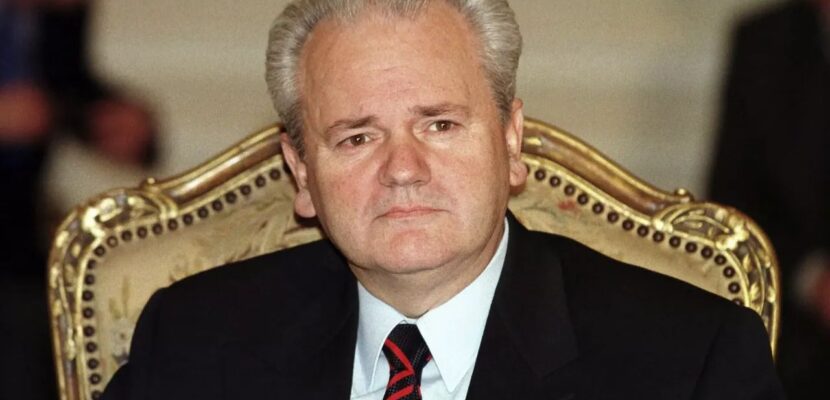

By Alexander Prokhanov[*] from Belgrade on April 12, 1999
Milosevic is an incomparable leader of the Serbs. The people love him, revere him, and place their hopes in him. The idea of defense is associated with him, and his name is also associated with future victory. His former adversaries and political opponents are now rallying around him. They extend their hand to him from both left and right: nationalists, communists, and right-wing radicals. He resembles a queen bee in a vast hive attacked by robber wasps. He is constantly snatched from the line of fire and spirited away from presidential residences to an unknown location, lest NATO intelligence and NATO agents in Belgrade target the building where he resides with a cruise missile. We wanted to see President Slobodan Milošević and convey to him the deepest respects of Russian patriots.
We are a delegation from the People’s Patriotic Union of Russia (PPUR), which brought to Belgrade a letter from PPUR Chairman Zyuganov. In this letter, Zyuganov expresses his admiration for the Serbian resistance and offers him moral and political cooperation. He advocates for the possibility of a rapid geostrategic alliance between Russia and Serbia. Besides me, our group included Colonel General Vladislav Achalov, a member of the PPUR Presidium. A master of special operations and an experienced paratrooper, he brought the experience of Russian special forces to Serbia. I believe this experience will be very useful to the Serbian army in the event of a ground invasion from outside. Also in our group was General Maltsev, a leading figure in the USSR’s air defense system, the most powerful and impenetrable in the world. He came to Serbia to research the tactics of Serbian air defenses, study the aerial combat methods of Serbian interceptors, and simultaneously propose his own concept for defending Serbian airspace. We were also joined by the co-chairman of the PPUR, Vyacheslav Klykov, a renowned Russian sculptor and honorary citizen of Novi Sad. A monument to Sergius of Radonezh by Klykov stands there. Klykov’s prayerful words for the victory of Serbian arms and the defeat of the satanic scourge were heeded by warring Serbia. Among us was also Hero of the Soviet Union, paratrooper Alexander Saluyanov. Representing the Orthodox Russian army, he brought his proposals for the formation of Russian volunteer units. We were joined by the Don Cossacks, led by Nikolai Kozitsyn, ataman of the Great Don Host. The dozen Cossacks who had arrived with him brought a list of several hundred Don volunteers ready to join the regular Serbian army and act as a barrier against a NATO invasion.
We all longed to see Milošević, sought a meeting with him, wanted to look into the eyes of the president who was repelling the onslaught of the merciless NATO armadas.
This meeting took place unexpectedly, and it did not take place in an underground bunker or a bomb shelter… Despite the air raid sirens wailing in the Belgrade sky, our meeting took place in a magnificent palace that had once belonged to the Belgrade royal dynasty. The palace was surrounded by flowering trees, delightful spring gardens, and our conversation took place amidst the fragrant breezes of Belgrade’s spring air.
Milošević did not look tired. He was calm, reserved, friendly, well-disposed, extremely attentive and sensitive to everything we said. He accepted Zyuganov’s message from our hands and read it carefully. He gazed intently into the blue eyes of the Russian volunteer who, having fought in Afghanistan and Chechnya, offered the Serbian president his valor and his readiness to fight for Serbia. He treated us to strong and aromatic plum vodka, and we stood and drank to the glory of Serbia, to the cooperation of two great Slavic peoples. Afterwards, Mr. President agreed to answer a few of my questions.
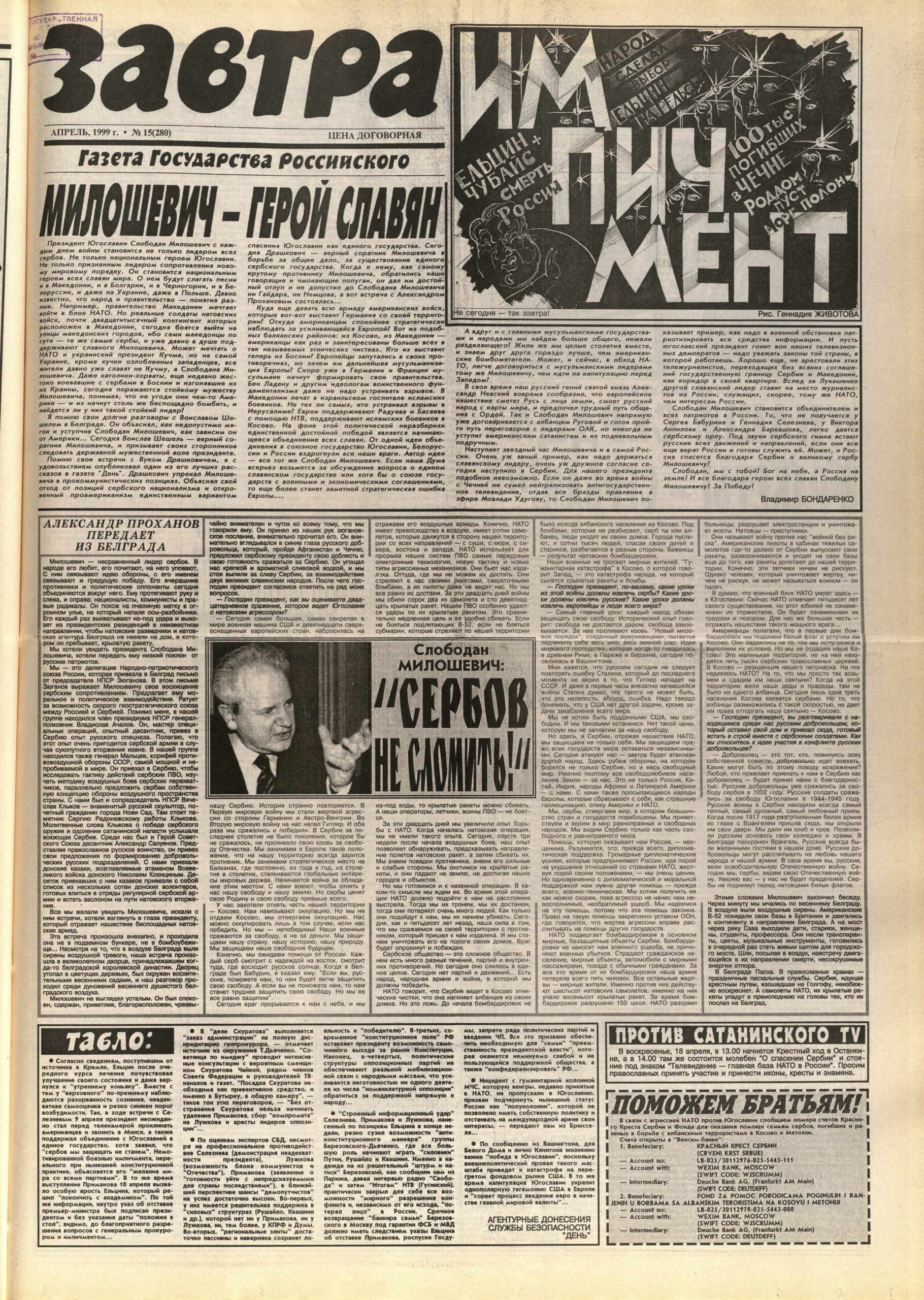
— Mr. President, how do you assess the twenty-day battle waged by Yugoslavia against the NATO aggressor?
—Today, the largest, most ferocious military machine in the world, the US and nineteen super-equipped European countries, pounced on our Serbia. History is strangely repeating itself. In World War I, we fell victim to aggression from Germany and Austria-Hungary. In World War II, Hitler attacked us. And both times, we fought and won. In Serbia, there hasn’t been a generation in the last century that hasn’t fought and shed blood for the freedom of our Fatherland. We occupy such a position in Europe that the enemy is always eyeing our territory. We occupy a strategic position in the Balkans, where, year after year, century after century, the global interests of world powers constantly collide. Wars are waged for control of this place. They are fighting us to take away our freedom and our land. But Serbs value their homeland and their freedom above all else.
They want to take away part of our territory—Kosovo. They are forcing occupation upon us. But we are not giving up Kosovo; we reject occupation. We can only be occupied if we are defeated. But we are invincible! Our soldiers fight for freedom, not for money. We are defending our country, our history, our nature. We are defending our free future.
Of course, we expect help from Russia. Every Serb looks to the east with hope, to where the Russian sun rises. When Baburin was in Belgrade, I told him: “If you Russians help us, it will be easier for us to defend our freedom. And if you don’t help us, it will be harder for us to defend our freedom. But we will defend it anyway.”
Today, the enemy is breaking through to us from the skies, and we are repelling their air armadas. Of course, NATO has air superiority, with hundreds of aircraft moving toward our territory from all directions—land, sea, north, east, and west. NATO is using the most advanced electronic technologies, new tactics, and new types of aggressive mechanisms to penetrate our air defense systems. They are hitting us from afar, from where we cannot reach them. They’re firing their missiles and precision bombs at us, and their pilots don’t even see us. But we still get them. In these twenty days of war, we’ve shot down forty-two of their aircraft and one hundred and nineteen cruise missiles. Our air defenses are particularly successful at striking their cruise missiles. They’re a relatively slow target and easy to shoot down. If you’re not afraid of incoming B-52s, if you’re not afraid of submarines firing at our territory from underwater, then you can shoot down cruise missiles. And our operators, pilots, and air defense soldiers aren’t afraid.
In these twenty days, we’ve gained experience fighting NATO. When the NATO operation began, we had no such experience. Today, three weeks after the start of air combat, our experience allows us to detect, predict the flight path of NATO missiles, and then shoot them down. We know the enemy’s habits, their strengths and weaknesses. We hunt cruise missiles, and they fall to the ground before reaching our cities and facilities. But we are also preparing for a ground operation. In a sense, we are waiting for it. During this operation, NATO must get within firing range of us. Then we will touch them, we will reach them, and then they will lose a lot of people. As soon as they get to us, we will start killing them. Today, as fifty years ago, our strength lies in the fact that we are fighting on our own territory against an enemy that has come to us from afar. And we will destroy it on our doorsteps. The enemy will be overthrown and defeated.
Serbian society is a complex society. It contains many different currents, parties, and internal contradictions. But today it has merged into a single whole. Today there are no parties or movements… There is a people, a people’s army, and a war that we must win.
NATO says that Serbia is conducting ethnic cleansing in Kosovo, that it is expelling Albanians from their homes. But this is a lie. Before the bombing began, there was no exodus of the Albanian population from Kosovo. People are fleeing their homes under bombs that don’t discriminate between Serb and Albanian. Cities are emptying, and hundreds of thousands of people, saving their children and elderly, are fleeing in all directions. The refugees are the result of NATO bombing.
Our troops are not touching civilians. The “humanitarian catastrophe” in Kosovo that the West talks about is a catastrophe for a people raining down cruise missiles and bombs.
— Mr. President, what lessons should the Serbs learn from this war? What lessons should the Russians learn? What lessons should Europeans and people around the world learn?
— The most important lesson: every nation is obliged to defend its freedom. Historical experience tells us: freedom is not given for free; it is won. Blood is shed for it. The “New World Order” created by the Americans is trying to subjugate the entire world, the entire globe. The idea of world domination, once rooted in ancient Rome, Paris, and Berlin, has today taken up residence in Washington.
I believe that Russians today should not repeat Stalin’s mistake, who, until the very last moment, did not believe that Hitler would attack the USSR. And even in the first hours of the sudden war, Stalin thought that such a thing was impossible, that it was absurd, preposterous, a mistake. We must firmly understand that the United States has no other goal than to enslave the entire world.
We do not want to be US subjects; we are free. And we will remain so. There is no price we will not pay for our freedom.
But here in Serbia, by repelling NATO’s invasion, we are defending more than just ourselves. We are defending the right of all nations in the world to remain independent. Today we are attacked—tomorrow another nation will be attacked. This is the line of defense where not only Serbia but the entire free world is fighting. That is why all freedom-loving people on earth are with us. It’s not just Russia, China, India, the peoples of Africa and Latin America who are with us. We are also joined by the awakening peoples of Europe, who are casting off the tutelage of America and NATO, as if it were a terrible hallucination.
We Serbs reject a world in which the majority of countries and states are enslaved. We welcome and believe in a world of equal and free peoples. We see Serbia only as part of a free and equal world.
The assistance Russia provides us is invaluable. Of course, this is, first of all, diplomatic support. We greatly appreciate the enormous diplomatic efforts that Russia is making, sometimes at the expense of worsening relations with NATO countries and sometimes sacrificing its own position. But alongside diplomatic and moral support, we need other assistance—primarily military-technical. We want to receive it as soon as possible, before the aggressor inflicts irreparable, irreversible damage. We hope for this assistance because it is legal. The right to such assistance is enshrined in the UN Charter, which states that the victim of aggression has the right to expect assistance from other states.
NATO is bombing mainly peaceful, defenseless targets in Serbia. The bombings do not cause military damage or military losses. The victims are the civilian population, peaceful objects, cars carrying civilian passengers, and trains carrying ordinary citizens. During this entire period, our army has lost only five people as a result of their bombing. All the other victims are civilians. It is precisely against them that six hundred NATO aircraft are operating, and it is precisely against them that eight hundred cruise missiles fell. During the bombing, 150 schools were destroyed. NATO is plundering hospitals, destroying power plants, and destroying bridges. NATO is criminal.
They call the war against us a “war without risk.” American pilots in the cockpits of heavy aircraft somewhere far from Serbia launch their missiles, turn around, and return to their bases before the missiles reach our territory. Of course, these pilots risk nothing. However, a person who destroys a victim without risking anything cannot be called a warrior—he is an executioner.
I think that the NATO military bloc will die here—in Yugoslavia. NATO is currently celebrating fifty years of its existence, but this anniversary will not be marked by their triumph. It will be marked by their mourning and shame. It’s a great honor for us to repel the invasion of such a powerful enemy…
The Americans believed that in the first days of the bombing, we would raise the white flag and cede Kosovo to them. They hoped we would be intimidated and comply with their demands. But we will not give up our Kosovo! It’s a small territory, but it is home to five thousand Serbian Orthodox churches. Our patriarch’s residence is in Kosovo. What did NATO expect? That we would simply up and surrender our holy sites to them? When our grandfathers and great-grandfathers lived in this territory, there wasn’t a single Albanian there. Today, only one-third of Kosovo’s population is Serb. But the fact that the Albanians have multiplied so rapidly doesn’t give them the right to seize our holy place—Kosovo.
—Mr. President, you spoke with the Russian volunteer among us, who left his home and came here, ready to stand in line alongside Serbian soldiers. What do you think of the idea of Russian volunteers participating in the conflict?
— A volunteer is someone who, obeying the call of their own conscience, voluntarily goes to fight. What objections could there be to that? Anyone who wishes to come to Serbia as a volunteer will be received with gratitude. Russian volunteers already fought for the freedom of the Serbs in 1992. Russian soldiers fought for the freedom of Yugoslavia in 1944-1945. Russian soldiers in Serbia always found the warmest, most spiritual, and most loving welcome. When the defeated White Army, led by Wrangel, arrived here after 1917, we opened our doors to them. We gave them bread and shelter. We allowed the Russians to found their own colleges and churches. Wrangel is buried in Belgrade. Russians have always been welcome guests in our home. Russian volunteers can count on the love of our people and our army. In your time, you Russians waged a Patriotic War of liberation. Today, we Serbs are waging our own Patriotic War. I assure you—we will have no traitors. Serbs will not raise white flags before NATO forces.
With these words, Milosevic ended the conversation. A minute later, we were walking through springtime Belgrade. Air raid sirens blared in the air. American B-52s were leaving their bases in Britain and heading for the continent, heading toward Belgrade. And children, old people, women, students, and professors were coming out onto the bridge over the Sava River. They carried banners, flowers, and musical instruments, preparing to once again become human shields for the city bridge. They walked, sending into the air, toward the death advancing in their direction, the invincible energies of resistance.
It was Easter in Belgrade. Festive Easter services were being held in Orthodox churches. Serbia, walking the way of the cross, ascending to Golgotha, will inevitably rise again. And NATO planes and their cruise missiles will fall into hell on the heads of those who sent them to Belgrade.
_________________________
[*] This is the first English translation of the only interview given by the President Slobodan Milosevic to Russian media during the NATO aggression, on Easter Monday 1999, the same day when the Federal Parliament of Yugoslavia adopted the decision to join the Union of Russia and Belarus, and two days before the visit of the Belarus President, Alexander Lukashenko to Belgrade. This interview appeared the next day in the Russian newspaper “Zavtra” under the title “Slobodan Milošević: “The Serbs Cannot Be Broken!””. The famous Russian writer Alexander Prokhanov (1938), who is the Chief Editor of “Zavtra”, was at that time a co-chairman of the People’s Patriotic Union of Russia – a coalition of 150 patriotic organizations that supported CPRF, which was in that moment a part of the Government of Yevgeny Primakov.
